



Characteristics of the region and experimental site
The field experiment with sown corn (Zea mays L.) and common sunflower (Helianthus annuus L.) was carried out in 2023 and 2024 at the Centre for Plant Biology and Ecology of the Faculty of Agrobiology and Food Resources of the Slovak University of Agriculture in Nitra. The experimental area is geographically located in the west part of the Žitavská pahorkatina (hilly land) at an altitude of 170 – 175 m above sea level. The location of the research area is plain with medium-heavy loamy soil. The soil type of the area is Haplic Luvisols (HMa). The site is located in a corn production area and is classified as a very warm agroclimatic region, with an average rainfall of 320.3 mm from April to September.
The aim of the experiment was to compare the effectiveness of AZOTER® bacterial fertilizer (nonsymbiotic bacteria and according to AZOTER® F/SC products in combination with Trichoderma atroviride and Conithyrium sp. mycoparasitic fungi) applied to the soil during pre-sowing soil preparation. The experiment was also carried out to compare the effectiveness of AZOTER® F bacterial fertilizer and AZOTER® L foliar bacterial fertilizer at different nitrogen application rates (reduction by 30 or 50%) on the yield parameters of sown corn and common sunflower, in comparison with the control variants, especially with the variant fertilized with full NPK nutrition. For the purposes of the experiment, the fertilization rate was determined by agrochemical analysis for full nutrient replenishment. This experiment aimed to verify the effectiveness of AZOTER® F and AZOTER® L bacterial components in nitrogen reduction, while other fertilization parameters (P, K) were maintained at the same level in all fertilized variants.
A. SOWN CORN
Variants of the experiment
The experiment was carried out in several variants, including control variants – unfertilized and fertilized with a full dose of NPK, as well as in variants with AZOTER® F and AZOTER® L application at different doses of nitrogen fertilization. The experiment was based on a conventional form of cultivation and was carried out in three repetitions.
In the variant with a full dose of NPK, the application of the nitrogen dose was determined by the previous agrochemical soil analysis in 2024 (in the range of 277.05 kg N.ha-1) and in 2023 (in the range of 285.2 kg N.ha-1). In the variant with a reduced nitrogen dose by 30% compared to the monitored full N dose (N dose reduced by 83.12 kg.ha-1 or 88.56 kg.ha-1), AZOTER® F was applied at the standard recommended dose (10 l.ha-1 with 150-200 l of water, applied before sowing with immediate incorporation into the soil). In the variant with a reduced nitrogen dose by 50% compared to the monitored full dose of N fertilization (N dose reduced by 139.05 kg.ha-1 or 142.60 kg.ha-1), AZOTER® F was applied at the standard recommended dose (10 l.ha-1, 150 – 200 l H2O, applied before sowing with immediate incorporation into the soil) and a subsequent application of AZOTER® L fertilizer (10 l.ha-1, 150-200 l water, application in the growth phase of 6 – 8 leaves of the analysed crop).
Effect of AZOTER® F and AZOTER® L bacterial fertilizers on corn grain yield with a reduced nitrogen dose compared to full dose of NPK
| Fertilization variant | Yield in t.ha-1 | Increase of yield in t.ha-1 | N dose in kg.ha-1 | N savings in kg.ha-1 | ||||
| 2024 | 2023 | 2024 | 2023 | 2024 | 2023 | 2024 | 2023 | |
| 100% N dose | 7,52 | 7,73 | – | – | 277,05 | 285,20 | – | – |
| 70% N dose + AZOTER F | 8,32 | 8,12 | +0,80 | +0,39 | 193,93 | 196,64 | -83,12 | -88,56 |
| 50% N dose + AZOTER F + AZOTER L | 8,48 | 7,80 | +0,96 | +0,07 | 138,00 | 142,60 | -139,05 | -142,60 |
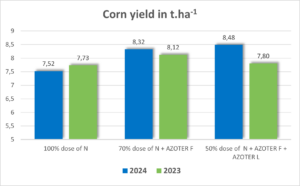
Graph No. 1: Corn grain yield in t. ha-1 at different fertilization variants and the use of AZOTER® F and AZOTER® L fertilizers in 2023 and 2024
Results (Sown corn)
In the experiment, the effect of AZOTER® F and AZOTER® L on the sown corn yield was monitored at different doses of nitrogen fertilization. The other fertilization parameters (P, K) in individual fertilization variants weren´t changed. The results of the two-year experiment confirmed the positive effect of AZOTER® F bacterial fertilizer (pre-sowing application) and the combination of AZOTER® F soil microbial fertilizer (pre-sowing application) with AZOTER® L foliar bacterial fertilizer (application at the 6th – 8th leave stage) on the formation of the sown corn yield. The results verified the positive effect of AZOTER® F fertilizer on soil that was adequately supplied with nutrients, both in the variant with the full dose of NPK fertilization, as well as when nitrogen fertilization was reduced by 30% and 50%. The results show that the application of AZOTER® fertilizers had a positive effect on the yield when the N fertilization dose was reduced.
In the variant with a 30% reduction of nitrogen dose and application of the standard dose of AZOTER® F, the corn grain yield of 8.32 t.ha-1 was achieved in 2024. It represented an increase in yield by 10.6% or almost by 0.8 t.ha-1 compared to the variant with only full dose of NPK fertilization (yield 7.52 t.ha-1). The saving of the nitrogen fertilization dose was by 83.12 kg.ha-1. The above repeated results under the same conditions confirmed the results from 2023, where the yield increase was by 5.04% with a nitrogen saving of 88.56 kg.ha-1. Using the two-year average of the achieved corn grain yields, the increase in this variant in the monitored period 2023-24 was 7.8% or 0.60 t.ha-1.
In the variant with a 50% reduction of the total N dose and a combination of the standard dose of AZOTER® F soil fertilizer and AZOTER® L foliar application, the corn grain yield of 8.48 t.ha-1 was achieved in 2024. It represented an increase in yield by 0.96 t.ha-1 compared to the variant with a full dose of NPK fertilization (yield 7.52 t.ha-1) with nitrogen saving by 139.05 kg.ha-1. Repeated results under the same conditions confirmed the results from 2023. They showed that with a 50% reduction in nitrogen fertilization in soil that was adequately supplied with nutrients, it was possible to maintain or increase the corn yield using AZOTER® preparations.
xxxxxxxxxxxxxxxxxxxxxxxxxxxxxxxxxxxxxxxxxxxxxxxxxxxxxxxxxx
B. COMMON SUNFLOWER
Variants of the experiment
The experiment was carried out in several variants, including the control variants – unfertilized and fertilized ones with a full dose of NPK, as well as the variants with AZOTER® F and AZOTER® L application at different doses of nitrogen fertilization. The experiment was based on a conventional form of cultivation and was carried out in three repetitions.
In the variant with a full dose of NPK, the nitrogen dose was determined by the previous agrochemical analysis of soil in 2024 in the range of 173.45 kg N.ha-1 and in 2023, in the range of 267.7 kg N.ha-1. In the variant where the nitrogen dose was reduced by 30% compared to the monitored full N dose (N dose reduced by 52.04 kg.ha-1 or 80.80 kg.ha-1), AZOTER® F was applied at the standard recommended dose (10 l.ha-1 with 150-200 l of water, applied before sowing with immediate incorporation into the soil).
In the variant where the nitrogen dose was reduced by 50% compared to the monitored full dose of N fertilization (N dose reduced by 86.72 kg.ha-1 or 133.85 kg.ha-1), AZOTER® F was applied at the standard recommended dose (10 l.ha-1, 150 – 200 l H2O, applied before sowing with immediate incorporation into the soil) and with a subsequent application of AZOTER® L fertilizer (10 l.ha-1, 150-200 l water, applied in the growth phase of 6 – 8 leaves of the analysed crop).
Effect of AZOTER® F and AZOTER® L bacterial fertilizers on common sunflower seeds yield with a reduced nitrogen dose compared to full dose of NPK
| Fertilization variant | Yield in t.ha-1 | Increase of yield in t.ha-1 | N dose in kg.ha-1 | N saving in kg.ha-1 | ||||
| 2024 | 2023 | 2024 | 2023 | 2024 | 2023 | 2024 | 2023 | |
| 100% N dose | 3,24 | 3,14 | – | – | 173,45 | 267,70 | – | – |
| 70% N dose + AZOTER F | 3,72 | 3,36 | +0,48 | +0,22 | 121,41 | 186,90 | -52,04 | -80,80 |
| 50% N dose + AZOTER F + AZOTER L | 3,55 | 3,29 | +0,31 | +0,15 | 86,73 | 133,85 | -86,72 | -133,85 |
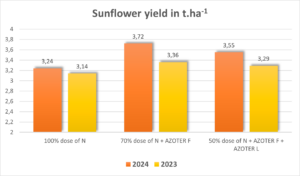
Graph No. 2: Sunflower seed yield in t.ha-1 with different types of fertilization and the use of AZOTER® F and AZOTER® L in 2023 and 2024
Results (Common sunflower)
The experiment monitored the effect of AZOTER® F and AZOTER® L preparations at different doses of nitrogen fertilization on the sunflower yield. The other fertilization parameters (P, K) in the individual fertilization variants did not change.
The results of the two-year experiment confirmed the positive effect of AZOTER® F bacterial fertilizer (pre-sowing application) and the combination of AZOTER® F soil bacterial fertilizer (pre-sowing application) with the foliar AZOTER® L foliar bacterial fertilizer (application in the 6th – 8th leave stage) on the formation of the common sunflower yield. The results verified the positive effect of AZOTER® F preparation on soil adequately supplied with nutrients, both in the variant with the full dose of NPK fertilization, as well as when the nitrogen fertilization was reduced by 30% and 50%. The results show that AZOTER® application had a positive effect on sunflower yield while reducing the N fertilization rate.
The variant with a 30% reduction in nitrogen dose and with the application of the standard dose of AZOTER® F, the sunflower yield in 2024 was 3.72.ha-1. It represented an increase of 14.8% or almost by 0.48 t.ha-1 compared to the variant with only full dose of NPK fertilization (yield of 3.24 t.ha-1). At the same time, saving of the nitrogen fertilization dose was 52.04 kg.ha-1. The above repeated results under the same conditions confirmed the results from 2023, where the yield increased by 7% with a saving of 30% of the N dose. When using the two-year average, the increase in the sunflower yield in this variant compared to the variant with the full dose of fertilization in the monitored period 2023-24 was 10.97% or 0.35 t.ha-1.
In the variant with a 50% reduction in the total N dose and a combination of the application of the standard dose of soil fertilizer AZOTER® F and foliar application of the preparation AZOTER® L, the sunflower yield of 3.55 t.ha-1 was achieved in 2024, which represented an increase in the yield by 0.31 t.ha-1, or 9.6% compared to the variant with the full dose of NPK fertilization, while saving the dose of nitrogen fertilization by 86.72 kg.ha-1. Repeated results under the same conditions confirmed the results from 2023, which showed that with a 50% reduction in nitrogen fertilization in soil adequately supplied with nutrients, it is possible to maintain or increase the sunflower yield using AZOTER® preparations.
Authors:
doc. Ing. Ivan ČERNÝ, PhD., SUA in Nitre,
doc. Ing. Ladislav VARGA, PhD., SUA in Nitre
The full version of the experiment is published at www.azoter.sk.
The experiment was carried out in cooperation with: AZOTER Trading s.r.o., Dúbravská 2, 841 04 Bratislava, Slovakia