
AZOTER Trading s.r.o., a branch office in Czech Republic, as a manufacturer of the AZOTER® product line in cooperation with Mendel University in Brno made an experiment, that was carried out in Žabčice at the Field Experimental Station of Mendel University in Brno. The aim of the experiment was to verify the effectiveness of AZOTER F bacterial fertilizeron on the yield of corn for silage and the possible savings on the applied dose of nitrogen fertilization.
Soil adjuvant based on AZOTER® fertilizer containing Trichoderma atroviride, improves the natural soil capabilities and strengthens the condition and immunity of cultivated crops at the same time. It significantly reduces the risk of primary infection of the root system and subsequently of the above-ground parts of plants. Trichoderma atroviride has a significant stimulating effect not only on the dynamics of plant growth, but also on plant resistance. It improves the defense reactions in cultivated crops and reduces the content of mycotoxins in the final production.
AZOTER® soil conditioners contain a mixture of bacteria that ensure a constant supply of necessary nutrients (N, P, K) for plants. After its application to the soil, intensive bacteria multiplication occurs which causes binding atmospheric nitrogen effectively and makes phosphorus and potassium available from less soluble forms. Its action in the soil creates a sufficient amount of nitrogen, phosphorus and potassium and produces substances in the form phytohormones, enzymes and vitamins at the same time. With the assistance of the microparasitic fungi, the plant also absorbs water and nutrients better. This is a liquid preparation that is always applied before sowing the plant. The field experiment was set up as a small-plot experiment. Three variants were designed and each variant had three repetitions to ensure the authenticity of the results. The first was a control variant, where fertilizer was applied before sowing at a dose of pure nutrients of 150 kg N/ha. In the second variant of the experiment, AZOTER F fertilizer as applied, where the nitrogen dose was the same as in the control variant (150 kg N/ha). In the third variant of the experiment, AZOTER F fertilizer as applied, but the nitrogen dose was reduced by 30 kg N/ha to 120 kg N/ha.
AZOTER F was applied at the recommended rate of 10 l/ha using a sprayer before the final soil preparation and was immediately incorporated into the soil. Subsequently, the crop – corn was sown.
During the vegetation period, two soil nutrient analyses were carried out to investigate nitrogen and phosphorus content in the soil and in the plant. The content of nitrogen was balanced in the 6th leaf of the plants and the content of phosphorus was slightly better in the variants with AZOTER F preparation. Another analysis of the plants was carried out during the flowering period. The nitrogen content in the plant was better in the control variant. The phosphorus content was better in the variants with AZOTER F preparation.
On August 14, 2024, the corn for silage was harvested. The weather in 2024, especially in the summer, was very tropical, and therefore the harvest took place in mid-August. Which also meant a shorter growing season (approximately one month). It also had an impact on shortening the effective time of action for bacteria that could still nourish the corn. Despite the shortened growing season, the results were positive in favor of AZOTER F preparation.
In variant 2 (150kgN/ha + AZOTER F) an increase in silage yield of more than 10%, or 5.3 t/ha compared to the control variant, was achieved. In variant 3 (120kg N/ha + AZOTER F) an increase in yield of 8.8%, or 4.6 t/ha compared to the control variant, was achieved, while saving was 30 kg N/ha.
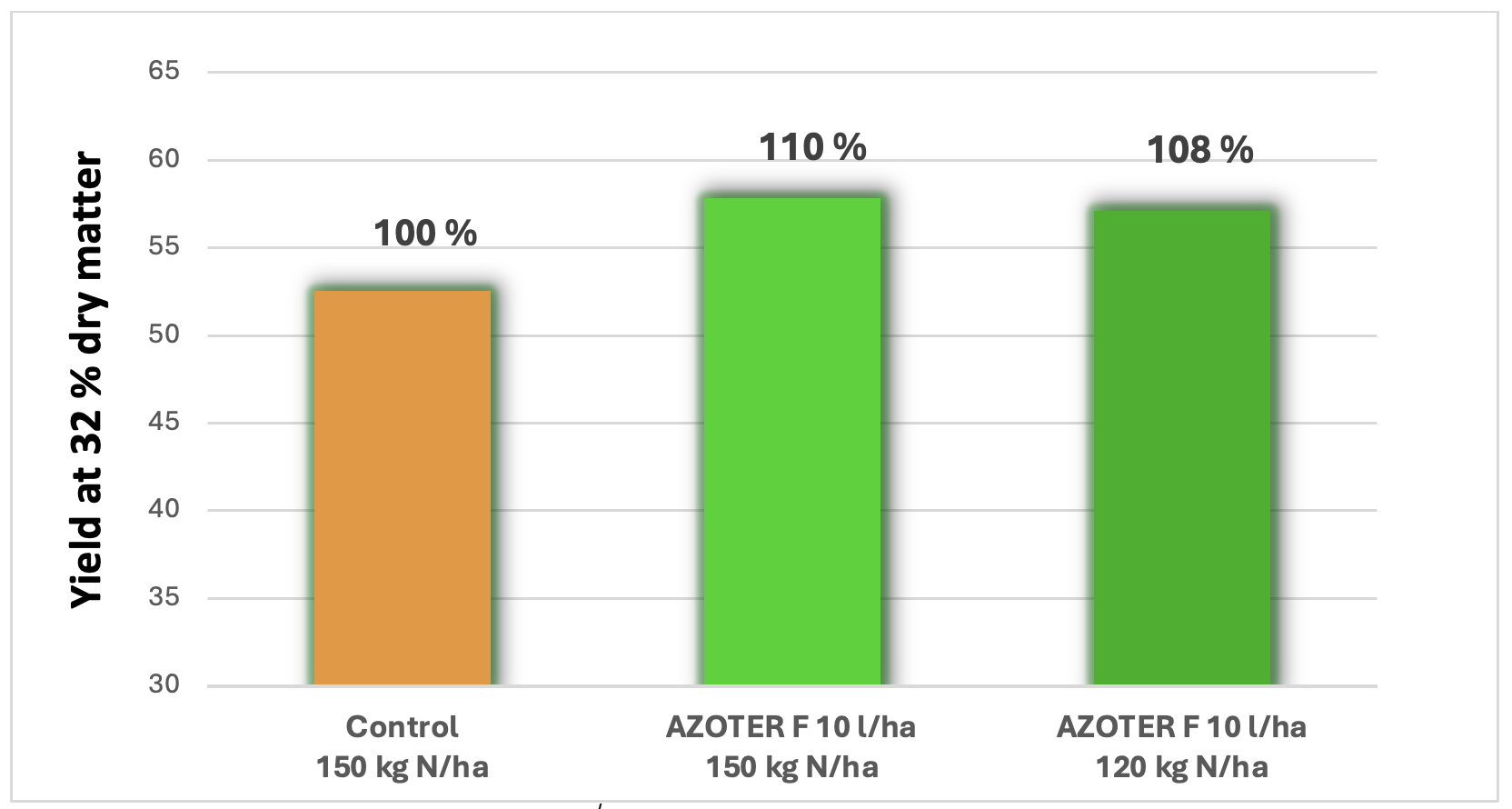
Graph No. 1 Silage corn yield (t/ha) at 32% dry matter
Conclusion:
Despite the early harvest and very warm summer months, when there was very little nitrogen release from the soil to the plant, the use of AZOTER F could help the plant with nutrition and thus achieve an increase in yield in both variants compared to the control – while maintaining the fertilization dose and reducing it by 20%. In the variant where the fertilization dose (150 kg N/ha) was maintained and enriched with AZOTER F fertilizer, there was an increase compared to the control variant by 5.3 t/ha of silage (10%). In the case of the variant where there was a 20% reduction in the fertilization dose (120 kg N/ha), the yield increased by 4.6 t/ha (8.8%) of silage but at the same time, using AZOTER F saved 30 kg/ha of nitrogen. Regarding the economic understanding of production, the results of the 3rd variant are interesting. They show that with the application of AZOTER F fertilizer, it is possible to achieve an appropriate reduction of N fertilization rate and the increase in yield at the same time.
Author: Ing. Jiří Suchodol
AZOTER Trading s.r.o.